
The first job of this property film is to identify the place correctly. Villa St. Maxime is in Saint-Paul-de-Vence, not in the town of Sainte-Maxime.
The distinction matters before any discussion of camera movement. An attractive film pointing viewers towards the wrong location has already failed an essential information test.
This case examines the published AchMedia archive and the owner's official website. It does not report a sale, a booking increase or a controlled marketing experiment.
Put the property name beside the town
The official Villa St. Maxime website identifies Saint-Paul-de-Vence as its location. It also provides separate routes for villa stays, room bookings and events. Those facts give the surrounding presentation a clear starting point. They do not establish current availability for a particular date or authorise a third party to confirm a reservation.
Keep the property name and town together in the page title, captions and shared excerpts. A shortened label can become ambiguous when detached from the website. The film may circulate through a publisher whose audience has never seen the collection page. Make that standalone version understandable. Do not rely on the viewer recognising the coastline, architecture or name from memory.
Read the aerial view as a relationship
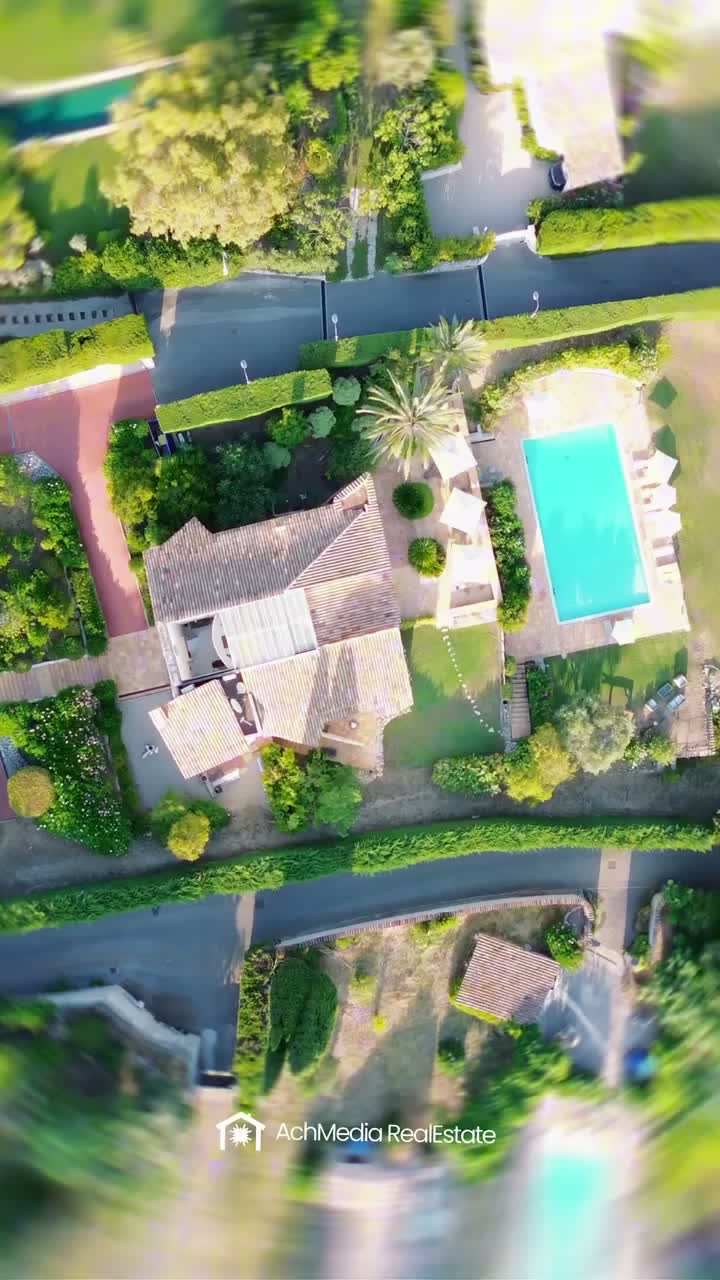
The top-down image places the villa and pool in the same frame. It gives the viewer a way to understand their relative position before reading the details. This is different from showing an isolated pool close-up. The wider view makes a spatial relationship visible, which is the reason to include it in a property presentation.
That view has limits. It does not establish legal boundaries, measured land area or ownership of everything visible around the building. Avoid graphic outlines unless their source and meaning have been confirmed. A confident line added during editing can look like documentary evidence. If the purpose is simply to orient the viewer, explain that purpose without turning the image into an unofficial survey.
Keep the companion film's subject distinct
The archive also contains a film over the heights of Vence. Its role is broader context rather than an interior tour of the villa. Naming the subject accurately helps the viewer understand why the sequence changes scale. The property and its surroundings can belong in the same presentation without every frame being treated as a view from the property.
Read the Saint-Paul-de-Vence production page alongside the archive references. A regional shot should not imply that a landmark is visible from every room. It should not establish a travel time or walking route either. Those statements require separate information. The practical question for the edit is how much context the viewer needs before returning to the named building.
Distinguish complete films from previews
The archive records complete versions as well as short viewing material. A preview is useful for browsing, but it is not the complete deliverable. Label the version being discussed. When citing a running time, say whether it belongs to the full film or the excerpt. Otherwise a technically accurate number can still describe the wrong file.
The table below identifies the complete Saint-Paul-de-Vence versions. The separately embedded location excerpt is silent and comes from the later media collection. It is not labelled as either complete film. This distinction lets the reader understand the work without suggesting that a muted loop demonstrates its sound design. Media metadata should describe the file actually embedded, not a different version in the archive.
Return to eye level for the route through the property
Aerial footage cannot fully explain how someone moves from a room to the terrace. A ground-level sequence can show the opening, the threshold and any steps. These details matter to the person imagining a stay or planning a visit. A smooth movement should preserve them rather than hiding the practical route in a quick transition.
For a new production, map the route before deciding which camera movement looks most striking. Identify where the viewer needs a clear connection and where a cut can shorten an obvious passage. Our property video guide explains this approach. The purpose is not to record every corridor. It is to avoid leaving the reader with a false arrangement of the important spaces.
Let a terrace show its actual relationship with the view
A distant view and a terrace shot do not automatically establish the same viewpoint. Record the position from which each was filmed. If a long lens or separate aerial position changes what is visible, avoid captions that collapse those viewpoints together. The owner can help verify which claims are appropriate for the public description.
Ground-level location footage from Saint-Paul-de-Vence appears separately in the media collection. Its caption identifies the place without assigning an unsupported property name. This is useful even when the image seems familiar. A production record should make the association explicit rather than relying on visual resemblance. Accurate attribution is part of the edit, not administrative work that can be postponed until after publication.
Plan light without promising permanent conditions
The pool and outdoor areas can look very different as the light changes. A late-day shot is a record of that filming moment. It should not become a claim that every terrace always receives the same sunlight. The film can use the light deliberately while the property information answers questions about orientation through suitable evidence.
Review the exterior sequence as a whole. Check whether adjacent shots imply continuous time when they were made under different conditions. There is nothing inherently wrong with combining them, but the description must remain honest. A viewer choosing a space for a specific use needs the owner's answer. An attractive sunset cannot confirm whether the place suits that activity.
Confirm flight feasibility for the exact site
A previous aerial shoot in the region does not establish permission for another property. The proposed aircraft, operation and location need their own assessment. The French aviation authority's guidance is a reference for the relevant operating categories and restrictions. The production team should confirm the applicable requirements before agreeing that a particular shot can be delivered.
Send the exact address and proposed purpose rather than just the words ‘French Riviera’. Explain access to the grounds and any privacy constraints. Agree how unsuitable conditions affect the schedule or alternative sequence. The drone property film service sets out these production questions. An owner agreeing to a shoot does not remove the need to check the wider operating environment.
Keep neighbours out of the property's promise
An aerial or elevated image may include neighbouring buildings, gardens or roads. Their presence can help orient the viewer, but it does not make them part of the property. Avoid descriptions that suggest exclusive surroundings when the frame does not support that claim. If an element is important to a visitor's decision, seek the appropriate confirmation rather than cropping the question away.
Privacy also needs a practical review. Inspect people, reflections and identifying details before publication. Agree which views should remain private or be omitted. These decisions should be documented in the production brief rather than improvised by the person making the final export. A film can explain the property clearly without treating everything visible beyond its walls as material freely available for promotion.
Design the next action around the actual purpose
The viewer may be interested in a villa stay, a room or an event. Those are different enquiries and should lead to the owner's relevant channel. The property detail page in French links to the official website. AchMedia's production role should stay distinct from the party confirming the arrangement. A film is not a reservation system.
If someone is commissioning a film for another villa, the next action is different again. They need the production brief and scope, not the booking page for this property. Our property video cost guide explains that discussion. Clear links can serve both audiences without turning the case study into an ambiguous offer to rent, buy and commission everything through the same button.
Report only the outcomes supported by records
This case can identify the location, published films and their documented running times. It cannot state how many bookings resulted from the work because no verified booking series is provided here. It cannot establish the value of the villa. The absence of those measures is not repaired by borrowing an industry statistic or a result achieved by another producer.
For a future report, define the measure and its observation period before publication. Keep views, clicks and enquiries separate from confirmed arrangements. Agree who can supply the outcome record and what may be shared. The film's quality and the clarity of its information can be reviewed directly. Causation requires more than putting a transaction date beside the date the video was uploaded.
Use the case as a briefing reference
The useful lesson is a sequence of information decisions. Name the villa and town accurately. Give the aerial view a clear spatial purpose. Return to the ground for circulation and keep each viewpoint tied to its actual source. Then send the viewer towards the responsible contact. These principles can inform another brief without pretending that every villa should receive the same film.
Compare this case with the Marrakech courtyard study and the Koh Samui villa. Their spaces call for different routes and different captions. The production standard remains the same: make the place understandable, preserve its identity and refuse to turn attractive footage into evidence it cannot provide.
| Film | Declared runtime | Recorded version |
|---|---|---|
| Saint-Paul-de-Vence | 35 seconds | Complete version in the manifest |
| The heights of Vence | 36 seconds | Complete version in the manifest |
Source: AchMedia film manifest: repo:src/lib/realEstateFilms.ts:133-134 and 147-148. These are declared complete-version times, not the silent excerpt below.
Frequently asked questions
Is Villa St. Maxime in Sainte-Maxime?
No. The owner's official website places Villa St. Maxime in Saint-Paul-de-Vence. Keep the town with the property name when sharing the film.
Do the aerial films show every room's view?
No. Aerial and ground-level camera positions differ. A particular room's view should be confirmed with relevant footage or information from the owner.
Does the embedded silent clip represent the complete films?
No. It is separate location footage. The complete archive versions and their running times are identified in the table.
Does this case study report a booking result?
No verified booking increase is reported here. The case documents production choices and the route to the owner's official information.