
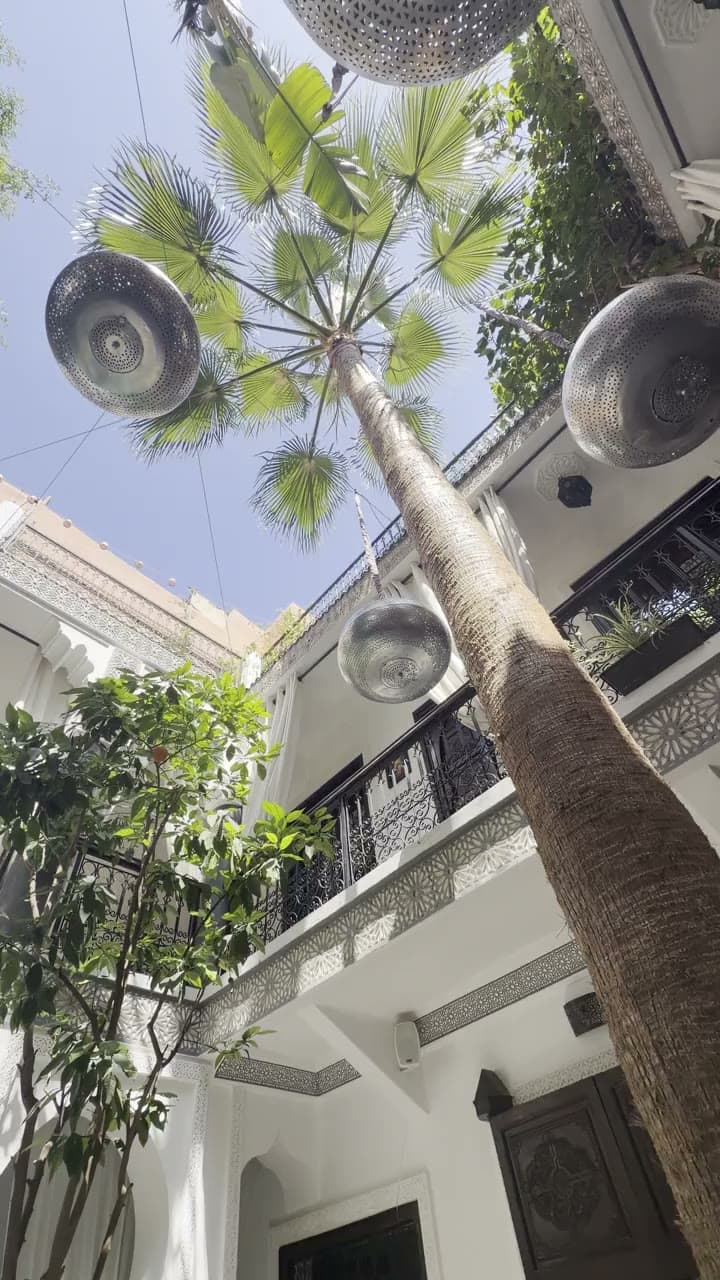
The courtyard at Riad O’Zeen offers more than an opening image. Its palm and surrounding galleries give the film a place to return to.
The AchMedia archive documents this riad in Marrakech. It does not establish its financial performance, present availability or the history of every decorative feature.
This case develops the spatial approach in our property video guide. The task is to make an identifiable place understandable through the footage that actually exists.
Begin with something the viewer can recognise
The courtyard poster shows a central palm, hanging lanterns and white galleries. The eye can follow the trunk towards the sky, then return to the surrounding levels. Those relationships make the frame useful as an anchor. After a close detail or a room sequence, a return to this view can restore the viewer's position.
That does not make the image a plan of the building. It cannot establish the number of bedrooms or the dimensions of the courtyard. Its value lies in the visible relationship between planting and architecture. Describe that relationship directly. The sequence becomes clearer when its caption explains what it shows instead of making the image responsible for facts outside the frame.
Build a route around the courtyard
A sequence of attractive spaces can leave the viewer unsure how they connect. Before filming, ask the owner to describe the route through the accessible parts of the riad. Mark the transitions that need an image of their own. A doorway, stair or gallery may explain more than another isolated decorative detail. The shooting plan should make room for those connections.
Do not cut between spaces in a way that invents a direct passage. A view from the courtyard does not explain how a guest reaches an upper gallery. Returning to the central palm can help orientation, but it cannot replace every missing transition. Our French-language preparation guide offers questions for identifying access and circulation before the camera arrives.
Show the galleries as spaces, not patterns alone
Repeated openings and railings can make a strong composition. They also belong to a building that people move through. When a gallery matters to the route, show its approach and direction. A detail of the railing can then enrich an already legible space. Without that context, the viewer may remember a pattern but not understand the place.
A low camera angle can emphasise apparent height. A particular lens can change the perceived depth of a passage. Review those impressions alongside the owner, especially where a room's relationship with the courtyard matters. No precise measurement should be inferred from the perspective. The film can present the space thoughtfully without describing the camera's impression as a surveyed architectural fact.
Give decorative details a location
The source manifest identifies zellige, door and lantern shots at Riad O’Zeen. Their attribution gives the editor a basis for using them within this case. A detail works best when its position is understandable. Show the surrounding doorway or gallery before moving closer. This lets the material contribute to the route instead of becoming a detached catalogue of textures.
Visible decoration does not establish its age, maker or provenance. Ask for documentation before adding those claims to a caption. Where that evidence is absent, describe the pattern, surface or visible fitting. Avoid using a general idea of Marrakech to fill the gap. The actual object can hold attention without an invented account of who made it or when.
Keep cultural context separate from property certification
The UNESCO entry for the Medina of Marrakesh provides official context for the historic city. It is not a certificate for this individual riad. A destination source cannot establish the building's restoration history, operating conditions or ownership. Those questions require information about the property itself. Keep the distinction visible when writing an introduction for readers unfamiliar with Marrakech.
A useful caption names the riad and describes the courtyard before introducing wider context. It does not borrow the authority of a city designation to authenticate every feature in the film. The same care applies to language versions and social posts. A shorter format does not justify turning a contextual fact into a claim that the underlying source cannot support.
Plan for the contrast between sky and covered space
The courtyard image contains open sky, foliage and covered galleries. These areas do not receive light in the same way. A location review should identify viewpoints that keep the important relationships readable. If a transition makes a gallery disappear into darkness, the sequence may lose the very information it was intended to explain. Technical choices should serve that spatial purpose.
The available poster does not reveal the exact shooting time. We do not reconstruct a schedule from the colour of the light. For a new commission, assess the actual conditions and available access windows with the owner. Ask which spaces matter most before arranging the sequence. A practical plan needs to respond to the building, not to an assumed universal courtyard timetable.
Treat the roof terrace as its own viewpoint
The archive also identifies a terrace sequence at the riad. A terrace can connect the film with its surroundings, but its viewpoint belongs to that position. Do not present an outlook from the roof as the view from every room. Keep the transition or caption that makes the location clear. A destination image and a room feature answer different questions.
If the edit needs additional context, obtain and label it separately. Footage from another property cannot stand in for a missing part of this riad. A wide city view should remain a city view. Our Marrakech production page distinguishes the location work from a sales or accommodation offer. The article should preserve the same distinction at the level of each shot.
Agree how filming fits around the people present
Confirm which spaces the crew may enter and when they become available. Guests, staff and visitors should not be treated as automatic participants in the film. Plan frames and access with the responsible person. Check reflections as well as the immediate camera view. Personal belongings and documents can appear in places that a quick room inspection misses.
Ask who can move objects or prepare equipment within the building. The camera crew should not improvise around sensitive fittings or occupied rooms. These arrangements belong in the brief and can affect the production scope. Our property video cost guide explains why a short final clip can still require careful preparation. Duration alone says little about the work needed on location.
Choose the viewpoint before assuming a drone
A courtyard or roof can suggest an overhead image, but that does not establish permission to fly. A Marrakech project requires checks appropriate to the actual location and equipment. French operating rules should not be transferred to Morocco by assumption. This article does not provide a flight clearance or a complete statement of local filming requirements.
A permitted gallery or terrace position may already show the relationship the viewer needs. Describe the resulting image according to its actual provenance. A high viewpoint is not automatically drone footage. Start with the question to answer, then assess a suitable method with the production team. The chosen technique should follow a useful purpose and the verified conditions of the project.
Publish a clip that remains understandable without sound
The courtyard excerpt presented here is silent. Its vertical frame follows the palm and surrounding architecture without relying on an interview or voice-over. Any accompanying text should name the riad and describe the relationship on screen. Do not promise narration that the file does not contain. If a later edit adds sound, review its permissions and factual wording separately.
A social post may be seen without the article that explains it. Give that post enough context to remain accurate on its own. A close view of a lantern should not become a claim that this is the city's finest riad. The footage can invite curiosity through a specific observation. Comparative praise requires evidence that this archive does not supply.
Direct each enquiry to the appropriate person
Someone interested in the film may want production work, accommodation information or a property discussion. Those requests should not receive the same answer. AchMedia's documented role here is production and presentation. The Riad O’Zeen property profile, in French, provides the available route towards the property contact. Current conditions must be confirmed by the responsible party.
The images do not support a rental return, occupancy claim or acquisition recommendation. A financial or legal project needs its own verified information and qualified local advice. For a filming brief, use our contact page. Describe the place, access and intended audience. The courtyard can organise a film; it cannot supply the missing evidence for an unrelated commercial promise.
Keep the archive record honest about dates
The source file and repository history establish the excerpt's measured duration and first publication. They do not establish the exact filming date. A publication record is useful provenance, but it should be named correctly. Likewise, the runtime describes the file available here. It is not a recommended visit length or evidence of audience attention.
Preserve that record when preparing another crop or language version. Keep the property attribution with the exported material, and review its captions when circumstances change. An archive can remain informative without pretending to be a current booking offer. Here, the useful evidence is concrete: a courtyard palm, white galleries, lanterns and the spaces connected to them. Those details are enough to begin an accurate story.
| Archive subject | Useful role | What it cannot establish |
|---|---|---|
| Courtyard palm | A recognisable return point | Dimensions or bedroom count |
| Gallery | An upper-level relationship | The complete access route |
| Zellige, door and lantern | Details within the place | Age, maker or provenance |
| Roof terrace | A particular external viewpoint | The outlook from every room |
Source: AchMedia editorial reading of the Riad O’Zeen entries in src/lib/realEstateFilms.ts and the original courtyard poster. Checked 12 September 2026; property profile in French.
Frequently asked questions
Is this footage actually from Riad O’Zeen?
The AchMedia source manifest attributes the cited sequences to Riad O’Zeen in Marrakech. This article follows those labels and does not fill gaps with images from another property.
Does the article establish the riad's heritage status?
No. The UNESCO source describes the Medina of Marrakesh. It does not certify this individual property or establish the history of its decorative features.
Does the publication date identify the filming date?
No. The repository documents first publication of the excerpt. The exact filming date is not established here, and we do not infer it from the light.
Can the film demonstrate rental returns?
No. The footage documents a production, not financial performance. Any investment analysis would require separate evidence and advice from appropriately qualified professionals.